The ultimate guide to stress-free skiing with children and why a catered chalet might be the best decision you ever make
Picture this: it’s 7am in the Alps. Snow is falling softly outside. Your children are still asleep, warm under duvets, while downstairs the smell of fresh coffee and bacon drifts up the staircase. Breakfast is already being prepared for you. Your ski passes are waiting on the hook by the door. The only decision you need to make today is which run to tackle first.
This is the reality of a catered chalet family ski holiday and if you’ve ever attempted a ski trip with young children staying in a hotel or self-catered apartment, you’ll understand just how extraordinary that scenario is.
Skiing with a family is one of life’s great adventures. But it’s also one of its more logistically demanding ones. Between packing the right gear, managing different ability levels, keeping everyone fed and rested, and navigating an unfamiliar resort, the sheer volume of decisions and responsibilities can turn what should be a relaxing break into an exhausting exercise in organisation.
Catered chalets cut through all of that. They provide a level of support, comfort, and convenience that transforms the family ski holiday from a survival exercise into a genuine luxury experience. In this guide, we’ll walk you through exactly why covering everything from mealtimes and childcare to the subtle psychological benefits of having your own private mountain home.
What Exactly Is a Catered Chalet?
Before diving into the family-specific benefits, it’s worth quickly explaining what a catered chalet actually is because many families, especially first-time ski holidaymakers, aren’t quite sure.
A catered chalet is a privately rented Alpine property typically a traditional wooden chalet or a luxury modern property that comes with a dedicated team of chalet hosts. These hosts live either on-site or very nearby, and their job is to take care of you throughout your stay. That means cooking and serving breakfast and a multi-course dinner every evening, keeping the chalet clean and tidy, providing afternoon tea when you return from the slopes, and generally acting as your personal concierge, local guide, and friendly problem-solver all rolled into one.
The standard package typically includes:
- Full cooked and continental breakfast each morning
- Afternoon tea with homemade cakes, snacks, and hot drinks when you return from skiing
- A three or four course dinner each evening, with wine and drinks often included
- Daily housekeeping beds made, bathrooms cleaned, living areas tidied
- Local knowledge and concierge support from hosts who know the resort inside out
Some premium chalets go even further, offering private chefs, chauffeured transfers, in-chalet ski hire fitting, hot tubs, cinemas, and dedicated childcare services. But even at the more modest end of the scale, the core catered chalet experience is transformative for families.
1. No More Cooking The Single Biggest Game-Changer
Let’s start with the most obvious benefit: someone else does the cooking.
This might sound like a small luxury. It is, in fact, a very large one especially when you’re travelling with children.
Think about a typical family ski day. You’re up early, getting everyone dressed in multiple layers of technical clothing, applying sunscreen to wriggling faces, tracking down the right gloves, finding a missing boot, calming a nervous child who’s had second thoughts about skiing. You finally make it out of the door. You spend six or seven hours on the mountain physically demanding, mentally engaging, genuinely wonderful. Then you come back exhausted, with cold, tired, potentially grumpy children who are hungry right now and don’t care that you still need to get changed, defrost your fingers, and figure out what on earth you’re going to make for dinner.
In a self-catered apartment or hotel restaurant, the evening can quickly unravel. Supermarket runs in ski boots are miserable. Cooking for a group after a full day on the slopes is draining. And hotel restaurants, while convenient, rarely offer the relaxed, home-like atmosphere that tired families actually need.
In a catered chalet, you walk through the door to the smell of something already cooking. Hot chocolate or mulled wine appears. The children can collapse on the sofa. Within the hour, a proper home-cooked meal is on the table one that’s been tailored to your family’s tastes and dietary needs, served in the warmth and comfort of your own private home.
The psychological impact of this cannot be overstated. It means the end of the ski day is something to look forward to rather than something to manage. It means parents can actually relax. It means evenings become the highlight of the trip rather than the most stressful part of it.
2. Mealtimes Adapted for Children
One of the biggest practical challenges of skiing with young children is food timing. Children particularly young ones operate on strict schedules. They need to eat at regular intervals, they need food they actually recognise, and they cannot politely wait until 8pm for a restaurant table to become available.
Good catered chalets understand this instinctively. Experienced chalet hosts who have worked with families know that children need to eat earlier than adults, often want simpler food, and that a tired, hungry child is no one’s friend.
Most family-friendly catered chalets will happily arrange:
- Early children’s dinners, typically around 5:30 or 6pm, so younger ones can eat, bath, and be in bed before the adults sit down to their own meal in peace
- Child-friendly menus that run alongside the adult courses things like pasta, pizza, chicken, and familiar favourites alongside whatever more sophisticated dishes the hosts are preparing for the grown-ups
- Flexible breakfast timing to accommodate those who want an early start on the slopes and those who prefer a more leisurely morning
- Afternoon tea that doubles as a children’s snack homemade cakes, biscuits, fruit, and warm drinks that keep small people going until dinner
This flexibility is something that no hotel restaurant can truly match. In a hotel, you’re working around their schedule. In a catered chalet, the hosts work around yours.
For families with babies and very young children, many chalets will also provide high chairs, children’s crockery and cutlery, and baby food warming facilities as standard. Some of the more luxury operators even stock specific brands of baby food or formula if you request in advance.
3. The Chalet Host: Your Personal Alpine Expert
The chalet host is perhaps the most underrated element of the catered chalet experience and for families, they are worth their weight in gold.
A good chalet host is far more than a cook and cleaner. They are someone who lives in the resort, knows it intimately, and has almost certainly hosted dozens of families before yours. They know which ski school is best for beginners, which slope has the most forgiving nursery section, which mountain restaurant does the best children’s portions, and which après-ski bar to avoid when you’ve got a five-year-old in tow.
For parents navigating a resort for the first time, this local knowledge is invaluable. You don’t need to spend your evenings scouring TripAdvisor. You just ask your host over dinner: “Where should we take the kids tomorrow? What’s the snow like on the blue runs towards the back of the valley? Is the ski school meeting point the same one we used yesterday?” They’ll know, and they’ll tell you.
Beyond the practical knowledge, there’s something deeply reassuring about having a consistent, friendly adult presence in your chalet who genuinely cares about making your trip work. If a child is ill and you’re not sure whether to push on or stay back, your host will advise. If someone’s equipment isn’t fitting right, they’ll call the rental shop. If the weather turns and you need to rethink your plans, they’ll suggest indoor alternatives.
For families travelling without extended family support, this kind of quiet, unobtrusive helpfulness can make an enormous difference.
4. A Home Away From Home Not a Hotel Room
Space is something that families on ski holidays desperately need and rarely get.
Hotel rooms, however nice, are fundamentally not designed for families. They’re small, they offer nowhere for children to spread out, there’s no communal space to gather in the evening, and the walls are invariably thin enough that bedtime routines become a diplomatic exercise in noise management.
Catered chalets are, by their very nature, houses. Real houses, with living rooms and dining rooms and kitchens and multiple bathrooms and crucially space. Space for children to play. Space for adults to decompress. Space for everyone to occupy a different corner of the building and not feel on top of each other.
The typical family catered chalet will offer:
- Multiple bedrooms with en-suite or private bathrooms, meaning the morning bathroom rush becomes a thing of the past
- A large, comfortable living area with sofas, a fireplace, and room for the whole group to gather in the evenings
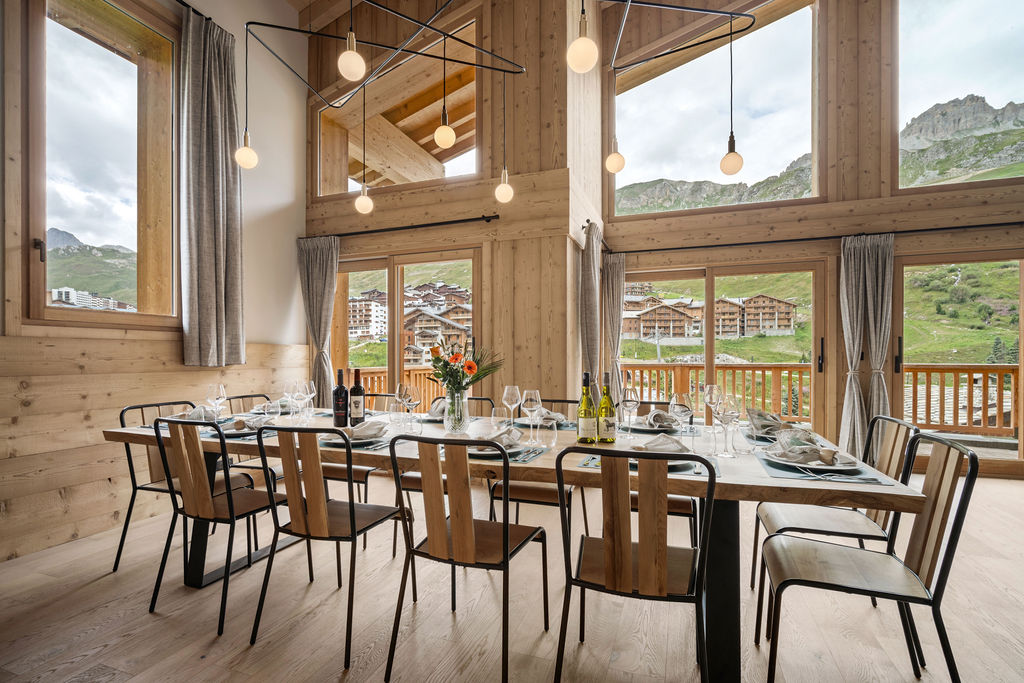
- A dedicated dining space where everyone eats together properly, around a table, like a family meal ought to be
- Outdoor space terraces, gardens, or balconies where children can play in the snow without being in the middle of the resort
- Extras like hot tubs, games rooms, or cinema rooms in many properties, giving the whole family something to do on rest days or bad weather days
This sense of genuine domestic comfort of having a home rather than a room is especially powerful when you’re travelling with children. Routine and familiarity matter enormously to young people. The ability to have a proper family dinner every night, to put children to bed in a real bedroom, to wake up and have breakfast at a table together these things create stability in an otherwise unfamiliar environment, which makes everything else easier.
5. No Supermarket Runs, No Meal Planning, No Arguments
Here is a scenario that will be painfully familiar to anyone who has attempted a self-catered ski holiday with a group:
Day two. Someone needs to do the shopping. Nobody wants to go. The supermarket is a twenty-minute walk in ski boots, or a ten-minute drive that requires someone to give up their skiing to make it happen. You eventually buy too much of some things and not enough of others. Someone forgets the thing the children will definitely eat. Dinner involves a half-hearted pasta that uses up whatever’s in the fridge. Someone grumbles. Someone else points out they’re on holiday.
In a catered chalet, none of this happens. The hosts handle all food procurement, all menu planning, all cooking, and all the washing up. You have zero involvement in the domestic machinery of feeding your family. None.
For parents, this is genuinely liberating in a way that’s hard to convey without having experienced it. The mental load of a family holiday particularly a ski holiday with all its additional equipment and safety considerations is enormous. Removing even one major category of that load (feeding everyone, three times a day, for seven days) has a disproportionately positive effect on the overall experience.
Parents can be parents present, engaged, having fun with their children on the mountain rather than project managers trying to keep a complicated domestic operation running in a foreign country.
6. Exclusive Use: Your Chalet, Your Rules
Many families choose to book a catered chalet on an exclusive use basis meaning the entire property is yours for the week, with no other guests. This is, for family groups, the absolute ideal.
Exclusive use means:
- You set the schedule. Dinner at 6pm? No problem. Later on a night when the children have had an afternoon nap? Fine. The hosts adapt to you, not the other way around.
- You decide the atmosphere. If you want a quiet evening where everyone’s in bed by 8pm, that’s your prerogative. If you want to be up late playing board games and the children are joining in until 10pm, nobody is disturbed and nobody is disturbing you.
- Children can be children. There’s no need to constantly manage noise levels for the benefit of other guests. Children can run around, be excited, have meltdowns, and be gloriously, appropriately young without anyone raising an eyebrow.
- Special occasions can be celebrated properly. Many families use a catered chalet as the setting for a milestone birthday, a significant family reunion, or simply an annual tradition. Exclusive use means you can bring decorations, request a special cake, or ask the hosts to arrange a themed dinner something no hotel could accommodate in the same way.
For large family groups multigenerational trips with grandparents, or multiple family units joining forces exclusive use also means you can all be under one roof together, sharing mealtimes and evenings in a way that a collection of hotel rooms could never replicate.
7. Childcare: The Option That Changes Everything
For families with very young children particularly those in the tricky window of being too young to ski but too lively to simply stay in a cot the availability of childcare through a catered chalet can be the single factor that makes a ski holiday possible at all.
Many catered chalet operators offer, or can arrange, on-site nanny or childcare services. This might mean a qualified nanny who is present from morning until evening, allowing both parents to ski without anyone staying behind. Or it might mean a more flexible babysitting arrangement for evenings, allowing parents to enjoy dinner and the occasional night out without worrying.
The key advantage of having childcare connected to your catered chalet is continuity. Your children are in their own home. They sleep in their own beds. The nanny gets to know them over the course of the week. There’s none of the stress of dropping a child at an unfamiliar crèche in an unfamiliar building in a foreign country.
For parents who love skiing but have felt it was impossible with a baby or toddler, this changes everything. It means both parents can actually ski. It means the holiday is genuinely a holiday for everyone.
Even for slightly older children who are in ski school during the day, having a nanny on hand for early evenings the notoriously challenging window between returning from the slopes and dinner can transform the dynamic for exhausted parents.
8. Ski School Logistics Made Simple
One of the less-discussed but genuinely stressful aspects of a family ski holiday is ski school logistics. Getting children to the right place, at the right time, with the right equipment and the right clothing, on multiple consecutive mornings, in an unfamiliar resort, often in the dark, is more complicated than it sounds.
Your chalet hosts can simplify much of this. Because they know the resort intimately, they can:
- Recommend the right ski school for your children’s ages and ability levels
- Explain exactly where the meeting points are and how to get there efficiently
- Help with equipment either by arranging in-chalet ski hire fitting (available through some operators) or by pointing you to the most reliable rental shop and helping you book in advance
- Sort ski passes many catered chalet operators will have ski passes waiting in the chalet on arrival, meaning you skip the queue entirely on that first precious morning
- Advise on timing which ski schools tend to run over time, which cafes near the meeting points are worth stopping at, how long the walk to the lift takes in ski boots with a small child in tow
This local, practical knowledge freely shared over breakfast or the evening before means you arrive at ski school feeling prepared rather than panicked. Over the course of a week, these small logistical gains add up to an enormous improvement in the overall holiday experience.
9. The Afternoon Tea Ritual: More Important Than You Think
One of the most underrated aspects of the catered chalet experience particularly for families is the afternoon tea.
When you return from a day on the slopes, typically in the mid-to-late afternoon, you will almost always find the following waiting for you: hot drinks (tea, coffee, hot chocolate), something freshly baked (cake, biscuits, scones), and often something more substantial (soup, sandwiches, savoury snacks). This is not an optional extra in most chalets. It’s part of the package.
For children, this is absolutely crucial.
Children who have spent a full day skiing physically demanding, emotionally intense, often more tiring than they realise need to eat when they get back. They need warmth, they need sugar, they need comfort, and they need it quickly. The gap between returning from the slopes and dinner is a notoriously dangerous window for family morale. Hungry, tired children become difficult children, and that difficult hour can cast a shadow over the entire evening.
Having food and hot drinks waiting the moment you walk through the door closes that window almost entirely. Children eat, warm up, and decompress. The mood stabilises. Everyone moves towards dinner in a manageable state rather than a fraught one.
It seems like a small thing. In practice, it’s transformative.
10. Rest Days Become Actual Rest Days
Every family ski holiday will include at least one or two days where someone can’t or won’t ski. A child who woke up with a cold. A parent whose legs have given out after too many mogul runs. A grandparent who simply wants a day off. A younger child who has had enough of ski school for one week.
In a hotel or self-catered apartment, a rest day can feel awkward and unproductive. You’re paying ski holiday prices to sit in a small room, slightly bored, slightly guilty.
In a catered chalet, a rest day is genuinely restorative. You have a comfortable home to be in. Your hosts are around to bring you tea, recommend a good book, or suggest a gentle walk into the village. If there’s a hot tub, you can spend the morning in it. If there’s a cinema room, you can watch films. If the chalet has a terrace with mountain views, you can simply sit and look at the scenery while everyone else is out skiing.
Children who need a quiet day have space to play indoors without being cooped up in a single room. They have toys, games, the television, and if the weather clears a garden or terrace to explore.
The chalet becomes a genuine base from which rest is possible, rather than something to be endured until everyone is well enough to get back on the mountain.
11. The Social Glue of Shared Mealtimes
There is something about gathering around a dinner table together each evening that has a particular power for families. Especially on holiday, away from the distractions and demands of everyday life, dinner in a catered chalet becomes the moment when the day is properly processed, stories are told, and the family actually connects.
Children recount their triumphant moments on the slopes the first time they made it down a red run, the moment they finally got the hang of turning. Parents share their own highlights. Grandparents offer encouragement. Everyone laughs about the falls, the queues, the unexpected moment when the youngest went faster than anyone expected.
The catered chalet provides the setting and the food. The family provides the conversation. Together, these shared dinners often become the memories that last longest from the trip not the skiing itself, but the evenings, the warmth, the togetherness.
This is something no hotel restaurant, with its background noise and formal service and other tables of strangers, can replicate. The privacy and intimacy of a catered chalet dinner is genuinely special.
12. Value for Money: Better Than It Looks
There is a common perception that catered chalets are an expensive luxury something for the very wealthy, not for ordinary families. In practice, this perception doesn’t survive close scrutiny.
When you properly cost up a self-catered ski holiday accommodation, food shopping for the week, eating out on the mountain, the inevitable restaurants in the evenings when everyone is too tired to cook, the wine, the après drinks the total is often surprisingly close to the cost of a catered chalet.
The difference is that in a catered chalet, you know exactly what you’re getting and exactly what it will cost. There are no unexpected restaurant bills. There’s no over-spending at a mountain café because you didn’t bring enough lunch. Your hosts will often pack a lunch for you to take on the mountain if you ask, or point you to the most reasonably priced spots.
For large family groups which tend to generate significant incidental food and drink spend the savings can be substantial. And when you factor in the additional value of the childcare support, the local knowledge, the ski pass organisation, and the time saved not cooking and cleaning, the value proposition of a catered chalet begins to look extremely compelling.
Many operators also offer a range of options across different price points. There are perfectly excellent catered chalets at the more modest end of the market that deliver the core experience good food, attentive hosts, a comfortable home without the luxury price tag of the top-end properties.
Choosing the Right Catered Chalet for Your Family
Not all catered chalets are the same, and for families specifically, it’s worth knowing what to look for.
Location matters enormously. A chalet that is ski-in, ski-out or very close to a lift removes one of the most logistically demanding parts of a ski day with children the morning schlep across the resort in full kit. Even being five or ten minutes closer to the lifts than another property can make a meaningful difference when you’re wrangling young children.
Check the children’s policies carefully. Does the operator offer a separate children’s dinner? Can they accommodate fussy eaters? Do they have high chairs and travel cots? Can they arrange childcare, or recommend trusted local nannies? A family-friendly operator will have clear, enthusiastic answers to all of these questions.
Think about the physical layout. Are the bedrooms well-separated so that children’s early bedtimes don’t disturb the adults? Is there a good living area for children to use without being underfoot in the kitchen? Is there outdoor space, even a small terrace, where children can play?
Consider what’s included in transfers. Many catered chalet operators include transfers to and from the airport, which for families arriving with mountains of luggage and multiple pieces of ski equipment is an enormous convenience. Check whether this is included or an extra.
Read reviews from other families. The best way to understand whether a chalet and its operators are genuinely family-friendly is to read what other families say about them. Look for specific mentions of how hosts handled children’s mealtimes, how flexible they were about scheduling, and how they responded when things didn’t go to plan.
A Typical Day in a Catered Chalet: The Family Experience
To bring all of this together, here’s what a typical day might look like for a family of four two parents, a ten-year-old and a six-year-old staying in a catered chalet in the French Alps.
7:30am: The smell of coffee and toast drifts upstairs. Parents dress the children while the hosts serve breakfast a cooked option alongside pastries, cereals, fresh bread, juice, and proper coffee. Ski passes are hanging by the door, organised by the hosts the previous day. No queuing required.
9:00am: The family walks five minutes to the ski school meeting point, guided by the host’s clear instructions from the previous evening. The six-year-old joins his group. The ten-year-old heads off with her parents, confident after yesterday’s runs.
12:30pm: Lunch on the mountain at a restaurant the hosts specifically recommended good food, fair prices, a children’s menu. The hosts’ table reservation meant no waiting.
4:00pm: Everyone back at the chalet. Hot chocolate, homemade brownies, and a sofa. The six-year-old is sound asleep within fifteen minutes. The ten-year-old plays on her tablet. The parents have a cup of tea and actually, genuinely, relax.
5:30pm: The hosts serve an early dinner for the children pasta and a mild tomato sauce, the six-year-old’s declared favourite, which the host noted on the first evening. The children eat, bath, and are in bed by 7:30.
8:00pm: A four-course dinner for the parents. A proper glass of wine. Conversation about the day without anyone interrupting. A dessert that someone else made. The mountain visible through the window, lit by moonlight.
This is the catered chalet experience for families. Not just convenient. Not just comfortable. Genuinely, meaningfully better.
Final Thoughts
Skiing with children is one of the most rewarding things a family can do together. It creates shared memories, builds confidence, teaches resilience, and gives children a physical skill and a love of the mountains that can last a lifetime.
But it is also hard. The logistics are demanding, the costs are significant, and the gap between a trip that works and a trip that doesn’t often comes down to how much support you have around you.
A catered chalet provides that support not in an intrusive, over-managed way, but in the quiet, thoughtful way of a well-run home. Food appears. The chalet is clean. Someone knows where to ski tomorrow and which restaurant does the best fondue. The children are accommodated and cared for. And at the end of each extraordinary day on the mountain, there is a warm, comfortable, private home to come back to.
For families, it isn’t really a luxury. It’s the most sensible, enjoyable, and ultimately most valuable way to ski.